Demo
Watch EAGG move across embodiments.
The video summarizes generated grasps, cross-end-effector behavior, and the visual result of geometry-aware conditioning.
Abstract
Align embodiment structure instead of hiding it.
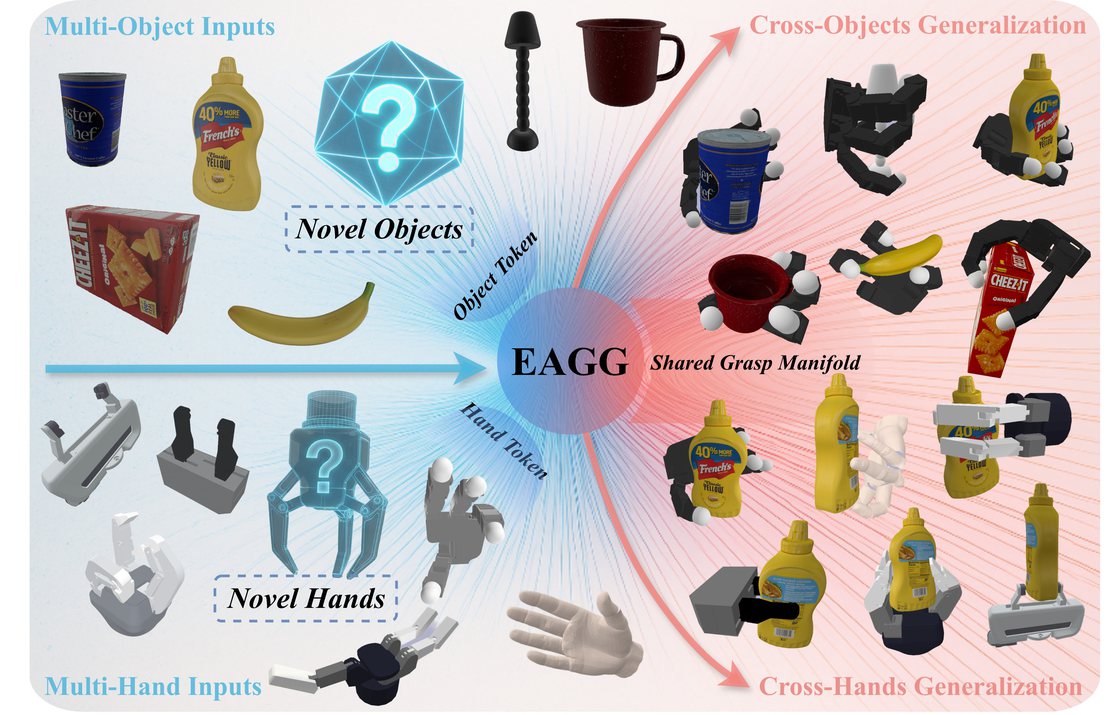
EAGG treats embodiment as a geometric and topological signal, not a static label.
Cross-end-effector grasp generation seeks a single model that can synthesize grasps for heterogeneous end effectors while preserving generalization across novel objects. Existing generators are typically designed for fixed embodiments or encode embodiment identity with static labels, weakening transfer when topology, actuation coupling, and contact geometry differ.
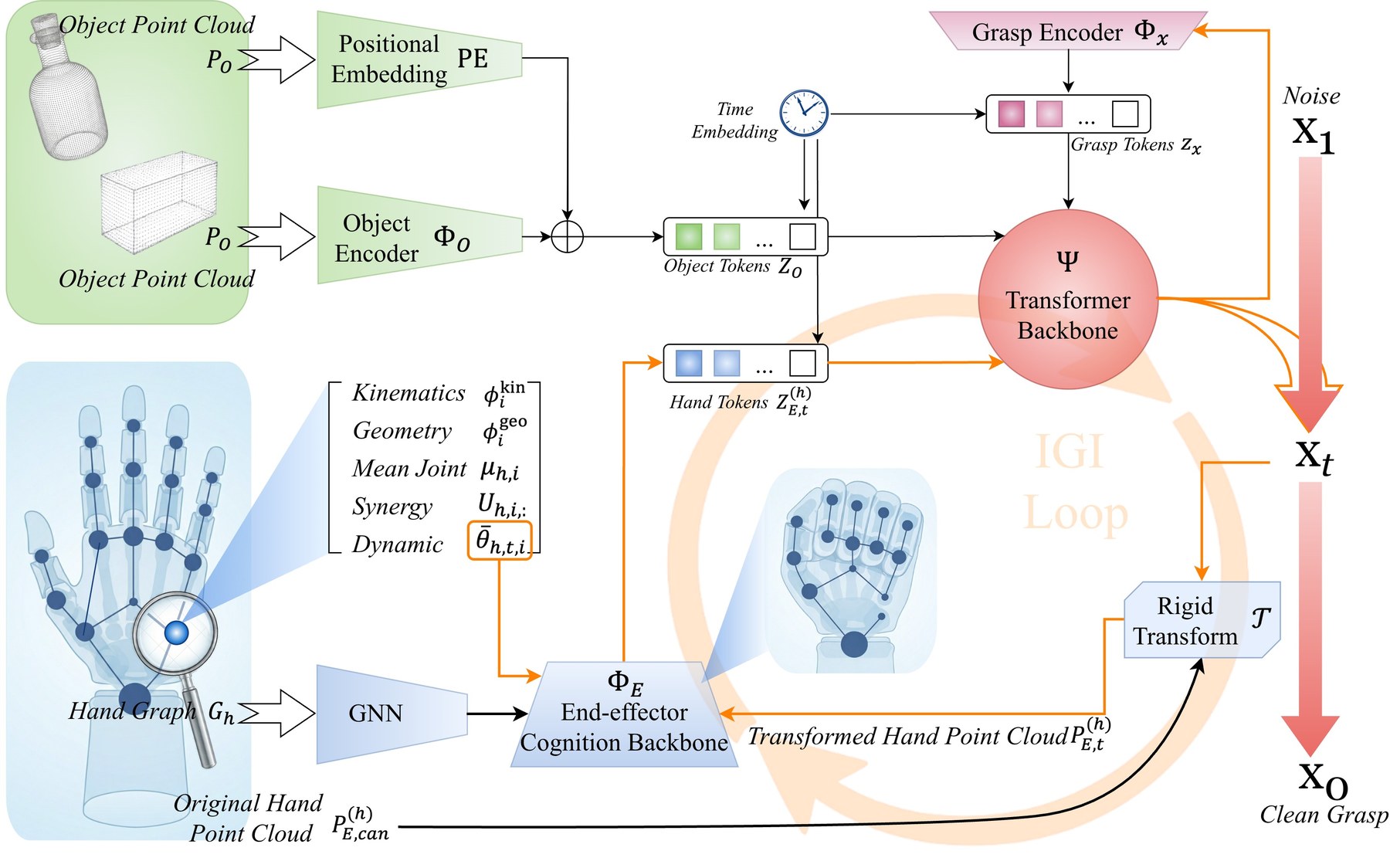
EAGG addresses this with an embodiment-aligned representation: each end effector keeps a topology-aware graph and a PCA-based low-dimensional control space. A frozen end-effector-cognition backbone converts articulated states into geometry-aware tokens, while iterative geometry injection keeps conditioning synchronized with the evolving grasp.
Method
Graph-conditioned generation with geometry refreshed in the loop.
Object tokens, grasp tokens, and end-effector tokens meet inside a transformer generator conditioned by morphology-aware structure.
Results
Cross-object, cross-hand, and hardware behavior.
Results use high-resolution paper figures where possible, with lightweight previews for generated grasp galleries.
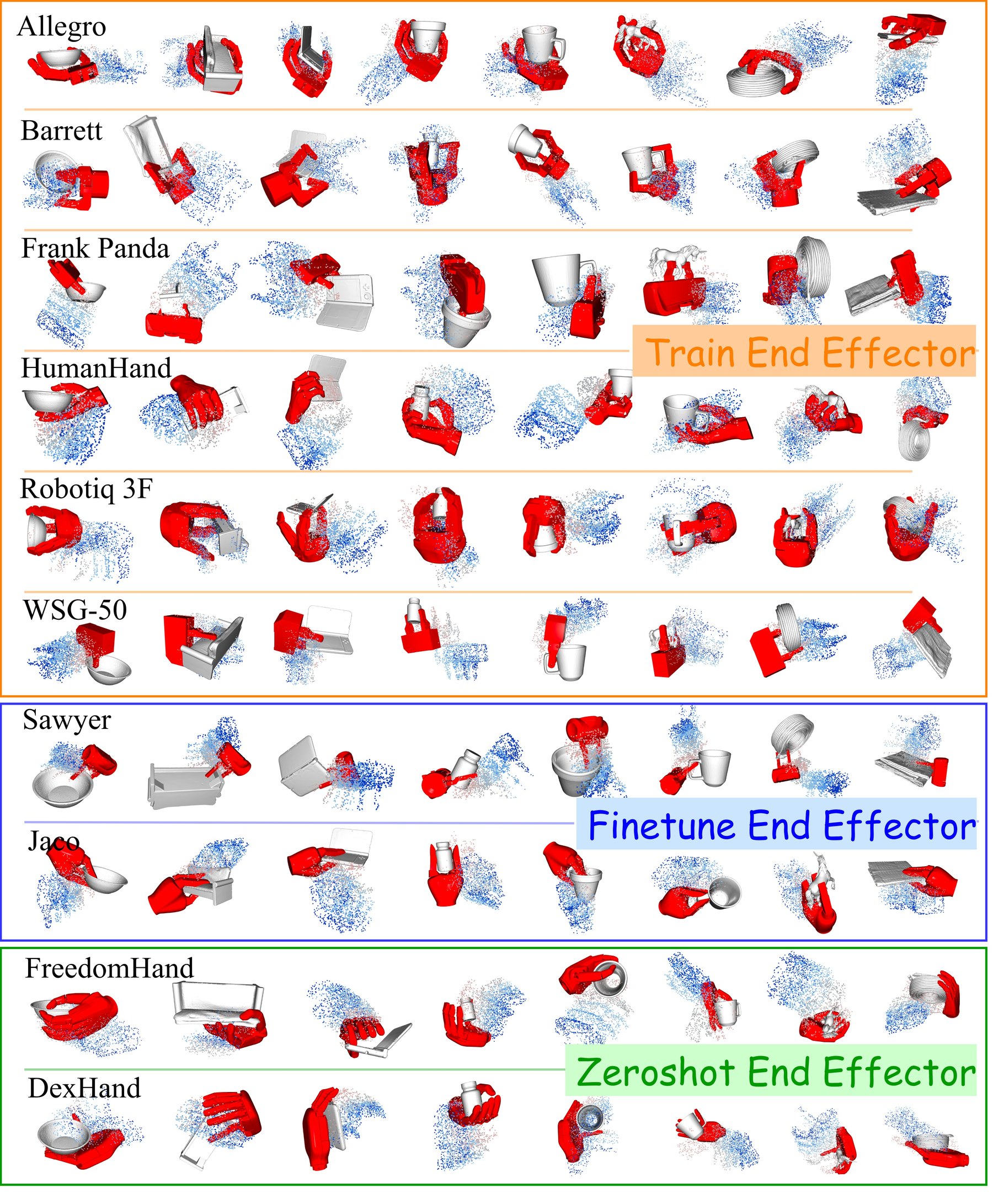
Cross-regime grasp synthesis
Generated grasps span training, finetuned, and zero-shot end effectors across object categories.
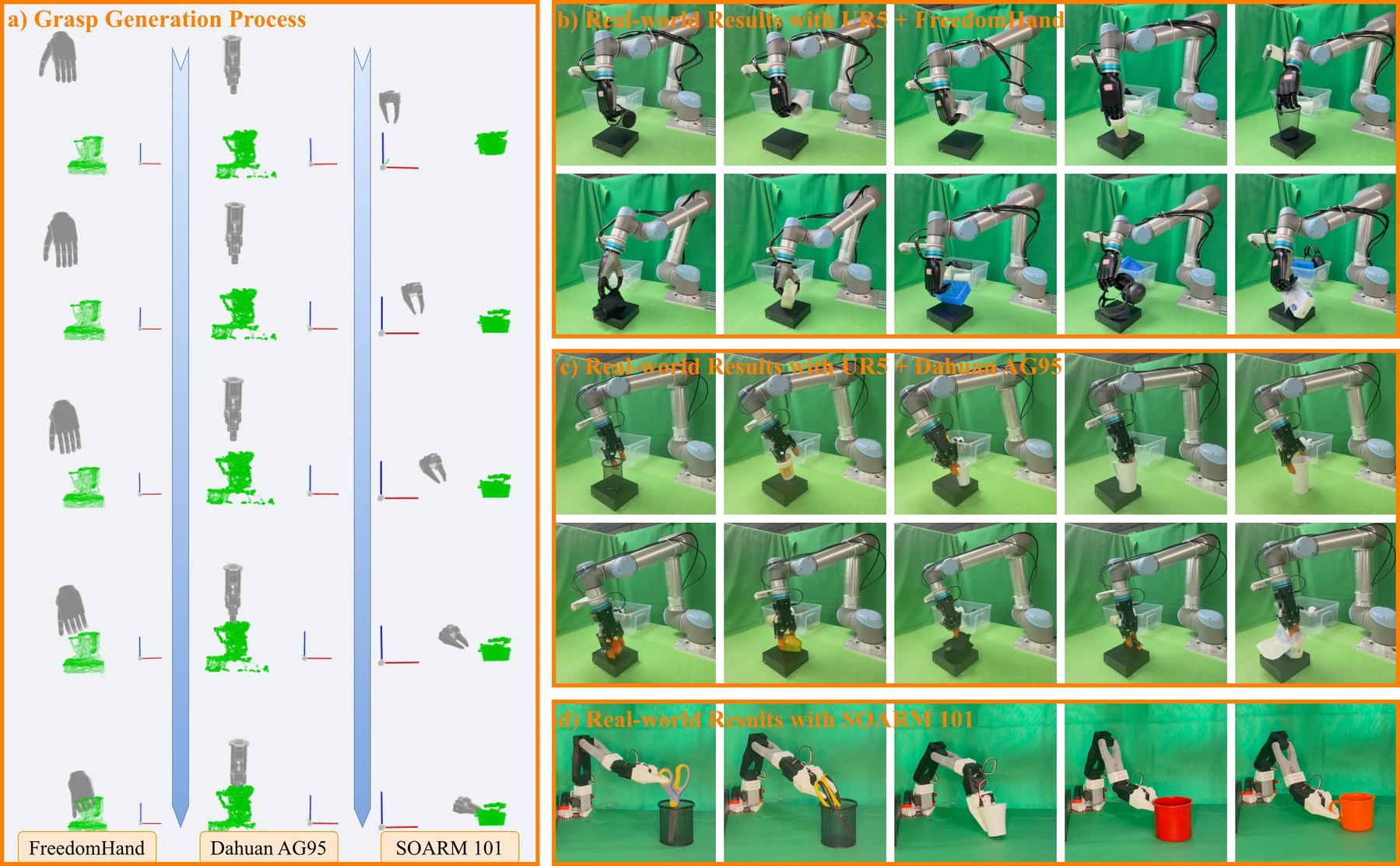
Real-world evaluation
Hardware trials cover FreedomHand, Dahuan AG95, and SOARM 101 setups in physical scenes.
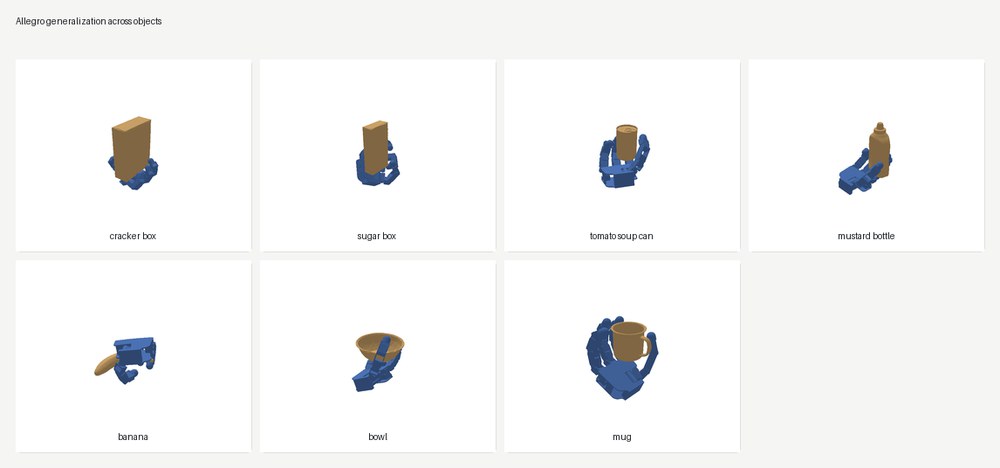
Cross-object gallery
The same embodiment is applied to multiple clean objects with ranked generated grasps.
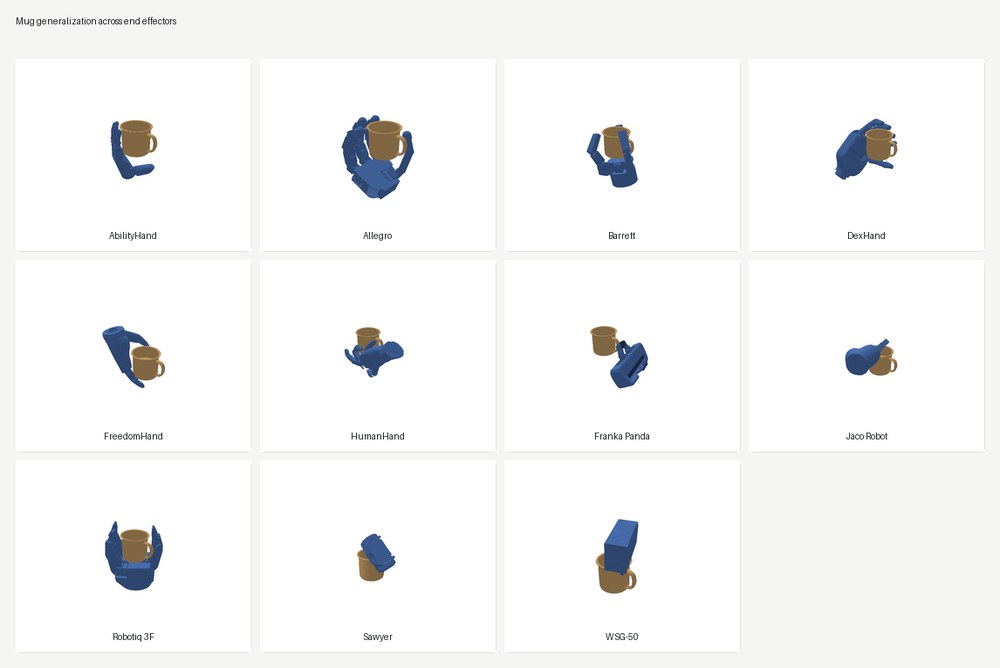
Cross-end-effector gallery
A fixed object is paired with different released hands and grippers to show embodiment transfer.
Resources
Paper, code, checkpoints, and dataset.
The project links stay compact and easy to scan, with citation separated below for direct copying.
Citation
Cite EAGG.
Use the BibTeX entry below if this work is helpful for your research.
BibTeX
@misc{niu2026eagg,
  title = {EAGG: Embodiment-Aligned Grasp Generation via Geometry-Aware Graph Conditioning},
  author = {Niu, Wanhao and Ke, Qiyan and Sun, Yuan and Sun, Hao and Xu, Jie and Ma, Muyuan and Hu, Ruiqi and Sun, Fuchun},
  year = {2026},
  eprint = {2606.18092},
  archivePrefix = {arXiv},
  primaryClass = {cs.RO},
  doi = {10.48550/arXiv.2606.18092},
  url = {https://arxiv.org/abs/2606.18092}
}